
Wisewand GEO: Get Your Articles Cited in AI Overviews and ChatGPT
What GEO Is, and Why Wisewand Rebuilt Around It
Wisewand's homepage used to sell one thing: SEO articles that rank. In 2026 the headline changed to "SEO + GEO: rank on Google and in the AI answers." That is not a marketing coat of paint. GEO, or generative engine optimization, is the practice of writing so that a language model can lift your passage into its answer and credit you for it.
The reason is uncomfortable but simple. A growing share of informational queries now resolve inside an AI Overview, a ChatGPT reply or a Perplexity summary. The user reads the answer and never scrolls to a blue link. Ranking third on a query that produces no clicks is a rounding error. Being the source the model quotes is not.
So the question this guide answers is narrow: what does Wisewand actually do differently when GEO is switched on, and what do you still have to do yourself? Our full hands-on Wisewand review covers the tool end to end. This one stays on GEO.
The Four Things a Model Needs From Your Page
After feeding a few dozen Wisewand articles into AI Overviews and Perplexity and watching which ones came back quoted, a pattern held. Passages get lifted when they are:
- Self-contained. The sentence answers the question without needing the paragraph above it. "It costs $56" is useless out of context. "The Wisewand 19-article prepaid pack costs $56, or $2.92 per article" survives extraction.
- Positioned early. Models weight the opening of a section heavily. A definition buried in paragraph six rarely gets pulled.
- Structurally marked. A question as an H3 followed immediately by a two-sentence answer is the single most quotable shape on the web right now.
- Specific. Numbers, dates, named entities and prices get quoted. Adjectives do not. "Very affordable" is invisible; "$0.77 per article on the Max annual plan" is citable.
What Wisewand Automates
Three of those four are now handled in the generation step.
Direct-answer openings
Wisewand opens each H2 section with a standalone statement rather than a transition sentence. If you have used older AI writers you will remember the "In today's fast-paced digital landscape" problem. Those runway sentences are exactly what a model skips over. Wisewand front-loads the claim instead.
Q and A blocks
The generator inserts explicit question-shaped subheadings drawn from the SERP analysis: People Also Ask entries, related searches, and the questions competitors answer. Each gets a short answer directly underneath. This is the highest-yield GEO structure available and it costs you nothing extra.
Schema.org markup
Articles ship with structured data: Article, FAQPage where Q and A blocks exist, and HowTo on procedural content. Schema is not a ranking factor for AI answers in any documented way, but it makes your content machine-readable without inference, which is the cheapest possible insurance.
Want to try this yourself? Try Wisewand today →
What You Still Have To Do
Specificity is not automatable, and this is where most Wisewand GEO articles fail. The model will happily write "Wisewand offers competitive pricing across several tiers." Nothing in that sentence can be quoted. You have to go in and replace it with the number.
My working rule after six weeks: every H2 section should contain at least one sentence that would still make sense if you emailed it to someone with no other context. That is roughly 30 seconds of editing per section, and it is the difference between an article that gets cited and one that does not.
The second manual job is sourcing. Wisewand's Advanced Information Research pulls verified data with sources, but it does not know which facts matter for your niche. Feed it the numbers you want quoted. If you want to be the page that answers "how much does X cost", the price has to be in the article, in a sentence, not only in a table.
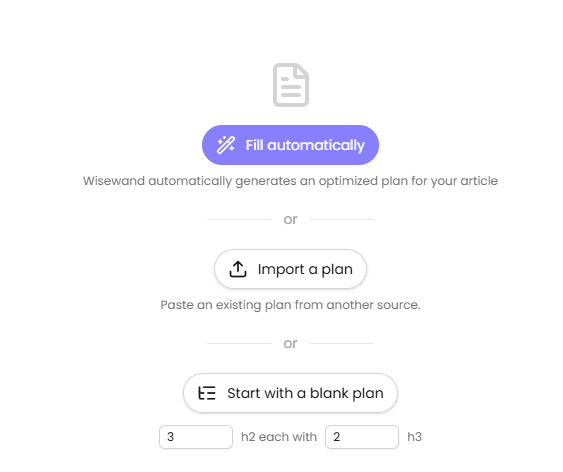
Step by Step: Configuring a GEO-First Article
The workflow below assumes Advanced Mode, because Autopilot gives you less control over structure. If you are unsure which to use, our Advanced Mode vs Autopilot comparison lays out the trade-off.
Measuring Whether It Worked
GEO measurement is genuinely harder than SEO measurement, and anyone who tells you otherwise is selling something. There is no impressions report for "times ChatGPT quoted you." What you can do:
- Prompt-test your own queries. Ask ChatGPT, Perplexity and Google AI Mode your target question monthly. Record whether your domain appears in the citation list. Crude, manual, and the only direct signal available.
- Watch Search Console for the impressions-without-clicks pattern. A query gaining impressions while CTR collapses usually means an AI Overview is now sitting above you, absorbing the click.
- Check referral traffic from chat domains. Perplexity and ChatGPT do send referral traffic when users click through. It is small, but it is real and it is attributable.
Do not expect volume. Expect a different kind of visibility, on a smaller number of high-intent queries, in a surface your competitors are mostly ignoring.
Ready to produce SEO content that ranks? Start writing with Wisewand →
How This Compares To Other Tools
Wisewand is not alone here. Frase shipped a GEO feature aimed at ChatGPT and Perplexity citations before Wisewand did, and if AI visibility is your only concern it deserves a look: we break the two apart in our Wisewand vs Frase comparison. What Wisewand adds is that GEO structuring sits on top of the SERP analysis and the affiliate mode, so you are not running a second tool to get it.
Generic assistants are the weakest option here, which is counter-intuitive given they are the AI. ChatGPT will write you a lovely article with none of the extractable structure, because it has no SERP data telling it which questions to answer. That gap is the whole argument in our Wisewand vs ChatGPT breakdown.
Pair GEO With Your Internal Linking
One underrated interaction: models follow internal links when they crawl for context, and a well-linked cluster gives them more surface to quote from on the same domain. If you have not built your semantic clusters yet, do that first with our internal linking guide and then layer GEO on top. Cluster first, quotability second, in that order.
Worth It?
GEO structuring is included on every Wisewand plan, including the $49/month Starter, so there is no upgrade decision to make here - see the full breakdown on our Wisewand pricing page. The real cost is the 30 seconds per section you spend making claims specific enough to quote.
My honest read: this is the highest-leverage change to the product since the affiliate mode, and it is early enough that most publishers in most niches are not doing it. That window will close. Get the Wisewand discount code here → | More answers in our Wisewand FAQ →

Arnaud
SEO publisher and tool tester since 2020. I test AI SEO writing tools hands-on - generating real articles, tracking rankings, and measuring ROI - so you don't have to gamble your budget.