
How to Maximize Your Wisewand SEO Score: 10 Actionable Tips
What Is the Wisewand SEO Score?
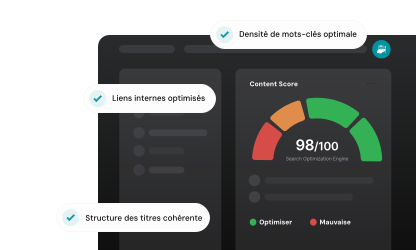
Every article you generate in Wisewand receives an SEO Score from 0 to 100. This score is your quality indicator - a real-time assessment of how well-optimized your article is for search engines before you even publish it.
These tips are based on 6 weeks of testing documented in our Wisewand review. Each tip is backed by real data and measurable score improvements.
During a live demo, one reviewer achieved a score of 90/100 on a freshly generated article. That's the ceiling for most content. In my experience, articles scoring 80+ consistently outperform those scoring below 70. The score isn't just a vanity metric - it correlates strongly with actual ranking performance.
But here's the thing: not every generated article hits 80+. Some land at 65-70, especially for competitive keywords or unusual topics. The good news? There are specific, repeatable actions you can take to push any article from the 65-70 range up to 80-85+.
How the SEO Score Is Calculated
While Wisewand hasn't published the exact algorithm (and several reviewers have noted this), the score appears to factor in:
- Keyword frequency and placement: Is the target keyword present in the title, H2s, first paragraph, and body at an appropriate density?
- Semantic coverage: Are related entities and synonyms present throughout the article?
- Content structure: Does the heading hierarchy follow a logical H2 → H3 pattern? Are there tables, lists, and other structured elements?
- Content depth: Is the word count competitive with what's currently ranking?
- Meta optimization: Are the meta title and description properly formatted and optimized?
- Internal and external links: Does the article include relevant links to both your site and authoritative external sources?
- Readability: Is the content structured for easy reading with appropriate paragraph lengths and formatting?
Tip 1: Configure a Detailed Persona
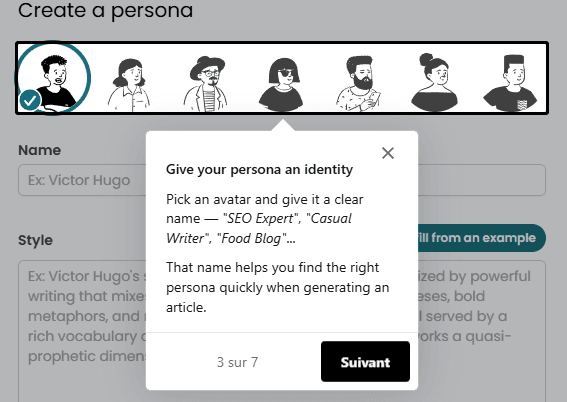
This is the single biggest score booster. Articles generated with a well-configured persona consistently score 10-15 points higher than those generated with a minimal persona.
Why? A detailed persona produces more specific, authoritative content with natural vocabulary variation. The AI writes with expertise rather than generic filler. This improves semantic coverage, keyword usage, and overall content depth - all factors in the SEO score.
If you haven't optimized your persona yet, read our complete persona setup guide first. It's the foundation everything else builds on.
Want to try this yourself? Try Wisewand today →
Tip 2: Use Advanced Mode for High-Value Content
Autopilot is great for efficiency, but Advanced mode gives you control levers that directly impact the SEO score:
- Target queries: Specify secondary keywords beyond the main keyword. This tells Wisewand exactly which semantic territory to cover
- Sources: Provide URLs of high-quality reference articles. The AI incorporates facts and data from these sources, boosting credibility and content depth
- Article length: Set it to match or exceed the average word count of top-ranking competitors (typically 2,000-3,500 words for informational content)
- Supplementary instructions: Add specific requirements like "Include a comparison table" or "Add a FAQ section with 5 questions"
In my testing, Advanced mode articles average 8-12 points higher on the SEO score than identical keywords in Autopilot mode - simply because you provide more context for the AI to work with.
Tip 3: Specify Target Queries (Secondary Keywords)
When using Advanced mode, the target queries field is your secret weapon. Here's how to use it effectively:
- Research your primary keyword using a tool like Ahrefs Keyword Generator or Google's "People Also Ask" section
- Identify 3-5 related queries that share the same search intent
- Enter them in the target queries field
Example: If your primary keyword is "best mechanical keyboard," your target queries might be:
- "mechanical keyboard buying guide"
- "mechanical keyboard switch types"
- "silent mechanical keyboard"
- "mechanical keyboard for office"
Wisewand weaves these secondary keywords naturally into the content, boosting semantic coverage. This alone can add 5-8 points to your SEO score.
Tip 4: Force Appropriate Article Length
Content depth is a significant score factor. Wisewand's automatic length mode bases word count on what's currently ranking - which is usually correct. But sometimes you need to override it:
- If competitors average 1,500 words: Set Wisewand to 2,000-2,500. Going 30-50% deeper can be a ranking advantage
- If competitors average 3,000+ words: Match their length. Shorter content will score lower on depth metrics
- Never force length without substance: 4,000 words of fluff scores worse than 2,500 words of dense, useful content. Wisewand generally handles this well, but review for padding
The Wisewand founders mentioned in their advanced tutorial that they've successfully generated articles up to 4,000 words without quality degradation - but only when the topic warranted that depth.
Ready to produce SEO content that ranks? Start writing with Wisewand →
Tip 5: Provide Quality Source URLs
In Advanced mode, you can provide source URLs that Wisewand uses as reference material. This is one of the most underused features - and one of the most powerful for SEO score optimization.
Good source URLs include:
- Government or institutional pages: Statistics, official data, regulatory information
- Industry research: Studies, whitepapers, annual reports
- Competitor content: The top 3-5 ranking pages for your keyword
- Expert content: Detailed guides from recognized authorities in your niche
When Wisewand has quality sources, it produces content with specific data points, cited statistics, and factual depth that dramatically improves the SEO score. As we showed in our Wisewand vs ChatGPT comparison, an article that says "many people use VPNs" scores lower than one saying "According to a 2025 Surfshark study, 31% of internet users worldwide use a VPN, up from 25% in 2023."
Tip 6: Optimize Meta Title and Description
Wisewand generates meta tags automatically, but reviewing them can add 2-3 points to your score:
Meta Title Checklist
- Under 60 characters (check the character count in Wisewand's statistics panel)
- Primary keyword near the beginning
- Compelling - would you click on this in search results?
- Include a modifier ("2026", "Complete Guide", "Tested")
Meta Description Checklist
- Under 155 characters (Wisewand occasionally generates descriptions that exceed this)
- Includes the primary keyword naturally
- Contains a clear value proposition
- Includes a soft CTA ("Learn how..." or "Discover the best...")
One reviewer noted that Wisewand occasionally produces meta descriptions that slightly exceed the recommended character count. A quick manual trim fixes this and ensures your full description displays in search results.
Tip 7: Enhance Internal Linking
Wisewand's automatic internal linking is excellent, but you can boost the score further:
- Add 2-3 strategic internal links: Link to your most important pages (money pages, pillar content) in addition to Wisewand's automatic contextual links
- Vary anchor text: Don't repeat the same anchor for the same target page. Use natural variations
- Link in the first 300 words: Early internal links carry more weight. If Wisewand hasn't placed one in the introduction, add one manually
For a deep dive on internal linking strategy, see our complete internal linking guide.
See these features in action: See current Wisewand pricing →
Tip 8: Add External Links to Authoritative Sources
External links to high-authority sources signal credibility to both readers and search engines. Wisewand adds some automatically, but ensure each article has:
- At least 2-3 external links to authoritative domains
- Links that support specific claims or statistics in your content
- Google's guidance on outbound links recommends linking to sources that add value for users
- Use
rel="noopener nofollow"for non-partner links to avoid passing PageRank unnecessarily
Tip 9: Include Structured Content Elements
Articles with diverse content elements consistently score higher than pure text. Ensure your article includes at least 3 of these:
- Comparison tables: Especially effective for product reviews and "best of" content
- Numbered lists: For step-by-step processes
- Bullet point lists: For features, pros/cons, and specifications
- FAQ sections: Target "People Also Ask" queries and capture featured snippets
- Key takeaway boxes: Summary sections that improve readability
- Images with optimized alt text: Wisewand's AI images come with SEO-friendly alt text
Wisewand usually includes several of these elements automatically, but if your generated article is heavy on paragraphs with few structural elements, consider asking for a regeneration with specific instructions: "Include a comparison table and an FAQ section with 5 questions."
Tip 10: Review and Iterate
The SEO score updates in real-time as you edit the article in Wisewand's editor. Use this to your advantage:
- Generate the article and note the initial score
- Check the weakest areas: Is keyword density low? Are there few internal links? Is the content shorter than competitors?
- Make targeted edits: Address the specific weak points rather than rewriting entire sections
- Regenerate sections if needed: If a particular section is weak, use Wisewand to regenerate just that section rather than the entire article
- Target 80+ before publishing: If you can't reach 80, the article might need a different approach - try Advanced mode with better sources or more specific target queries
Want to try this yourself? Try Wisewand today →
Score Benchmarks: What to Aim For
| SEO Score | Quality Level | Action |
|---|---|---|
| 90-100 | Exceptional | Publish with minor review. You hit the sweet spot |
| 80-89 | Strong | Ready to publish after standard review |
| 70-79 | Good | Apply 2-3 optimization tips before publishing |
| 60-69 | Needs work | Switch to Advanced mode, add sources and target queries |
| Below 60 | Weak | Reconsider the keyword or regenerate with a different approach |
Putting It All Together: My Optimization Workflow
- Generate in Advanced mode with persona, secondary keywords, and 2-3 source URLs
- Check the score immediately. If it's 80+, proceed to review. If it's below 75, I look at what's missing
- Verify meta tags: Trim meta description if over 155 characters, ensure keyword is in meta title
- Add strategic internal links: 2-3 links to my most important pages, placed naturally in the content
- Verify external links: Ensure at least 2 authoritative external sources are linked
- Check structured elements: At least one table, one list, and varied heading levels
- Re-check the score. It should be 80+ now. If not, the content needs more depth or the keyword might be too competitive for the current approach
This workflow adds about 10 minutes per article but consistently pushes scores into the 80-90 range. That extra 10 minutes translates directly into better rankings and more organic traffic.
Start Optimizing Your Content
The SEO score is your pre-publication quality gate. It won't guarantee page 1 rankings - that still depends on your domain authority, backlinks, and competition - but it ensures your content is technically optimized to compete. A well-optimized article with a strong score has the best possible chance of ranking.
All Wisewand plans include the SEO score feature. Check out available plans or use our exclusive promo code to start generating optimized content at a discount. Check our FAQ for common questions about SEO scores and credits.

Arnaud
SEO publisher and tool tester since 2020. I test AI SEO writing tools hands-on - generating real articles, tracking rankings, and measuring ROI - so you don't have to gamble your budget.